Saturday, August 8, 2009

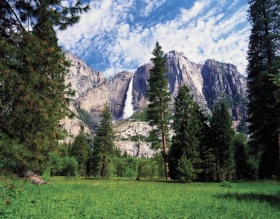
Can national parks be saved from global warming?

From: Margot Roosevelt, LA Times

The federal government must take decisive action to avoid "a potentially catastrophic loss of animal and plant life," in the national parks, according to a new report that details the effect of global warming on the country's most treasured public lands.

The 53-page report from the National Parks Conservation Assn., a Washington-based advocacy group, contains a litany of concerns related to climate change in the parks, from the bleaching of coral reefs in Florida to the disappearance of high-altitude ponds that nurture yellow-legged frogs in California.

The group, which has offices in California and 10 other states, called on the National Park Service to come up with a detailed plan and funding to adapt to temperature-related ecosystem changes.

"Right now, no national plan exists to manage wildlife throughout their habitat, which often is a patchwork of lands managed by multiple federal agencies, states, tribes, municipalities and private landholders," wrote Tom C. Kiernan, president of the group.

Article continues

How to Get Cancer: Move to the United States

From: Live Science

he risk of cancer for Hispanics living in Florida is 40 percent higher than for those who live in their native countries, a puzzling new study finds.

The finding holds even after researchers corrected for the increase detection rates in the United States. And access to health care

did not make things better.

"This suggests that changes in their environment and lifestyles make them more prone to develop cancer," said Dr. Paulo S. Pinheiro, a researcher in the Department of Epidemiology at the University of Miami Miller School of Medicine.

Cancers of the colon and rectum among Cubans and Mexicans who moved to the United States was more than double that in Cuba and Mexico. Lung cancer among Mexican and Puerto Rican women living in Florida was also double the rates in their countries of origin.

Article continues

Alaskan Glaciers REALLY are Shrinking

"Fifty years of U.S. Geological Survey (USGS) research on glacier change shows recent dramatic shrinkage of glaciers in three climatic regions of the United States. These long periods of record provide clues to the climate shifts that may be driving glacier change."

Beginning in 1957, the USGS has taken annual measurements of the South Cascade Glacier in Washington state, and followed shortly thereafter monitoring the Gulkana Glacier on the coast of Alaska and Wolverine Glacier in Alaska's interior.

All three glaciers have shrunk and thinned, the report says, with the mass loss rapidly accelerating over the past 15 years. The South Cascade Glacier has lost nearly 25% of its weight, and the two Alaskan glaciers about 15%.


Between 1987 and 2004 all three glaciers consistently lost more snow and ice each summer as compared to years prior, the report says. Combined with less snowfall the loss has led to the net decline of the glaceirs.
The study raises concerns about diminishing freshwater runoff and the future availability for fresh drinking water in areas that depend on the glaciers for water supply as they continue to shrink - some possibly disappearing entirely. The shrinkage also changes water temperatures, effecting the habitat of fish, insects, and other animals downstream, says USGS scientist Shad O'Neel.

Photo shows the South Cascade Glacier in 1928 (top) and now (bottom).

Article continues: http://www.globalwarmingisreal.com/blog/2009/08/07/usgs-report-shows-a-dramatic-decline-in-us-glaciers/

Saturday, July 25, 2009

China dust cloud circled globe in 13 days

China dust cloud circled globe in 13 days


Dust clouds generated by a huge dust storm in China's Taklimakan desert in 2007 made more than one full circle around the globe in just 13 days, a Japanese study using a NASA satellite has found.

When the cloud reached the Pacific Ocean

the second time, it descended and deposited some of its dust into the sea, showing how a natural phenomenon can impact the environment far away.

"Asian dust is usually deposited near the Yellow Sea, around the Japan area, while Sahara dust ends up around the Atlantic Ocean and coast of Africa," said Itsushi Uno of Kyushu University's Research Institute for Applied Mechanics.

Article continues

Ocean current switch due to warming could be slower than feared

CHICAGO — The nightmare global warming scenario which provided the plot for a Hollywood blockbuster -- the Atlantic Ocean current that keeps Europe warm shuts down and triggers rapid climate change -- has long worried scientists.

But a study published Thursday in the journal Science found it may not occur as quickly as previously feared.


There is evidence that this current has shut down with some regularity in the past -- and sometimes quite rapidly -- in response to large influxes of fresh water from melting glaciers.

However, it appears as though the current rate of glacial melt is occurring at a more gradual pace which will "give ecosystems more time to adjust to new conditions," said study coauthor Peter Clark, a professor of geosciences at Oregon State University.

Article continues

NOAA Reports Record Ocean Surface Temperatures for June

From: , Global Warming is Real, More from this Affiliate
Published July 21, 2009 07:30 AM

The National Oceanic and Atmospheric Administration (NOAA) has reported findings of preliminary analysis from the agency's National Climatic Data Center in Asheville, North Carolina that shows global ocean surface temperatures for June broke the previous record set in 2005.

The combined average global/land and ocean surface temperature for June was the second warmest on record, 1.12 degrees Fahrenheit (0.62 degrees Celsius) above the 20th century average of 59.9 degrees F.

Ocean surface temperatures for June '09 were the warmest on record, 1.06 degrees F (0.59 degrees C) above the 20th century average of 61.5 degrees F.

The global land surface temperature for June was 1.26 degrees F above the 20th century average, and the sixth warmest June on record.

Article continues: http://www.globalwarmingisreal.com/blog/2009/07/20/noaa-reports-record-ocean-surface-temperatures-f

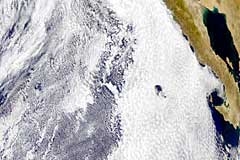
How Clouds Over the Oceans Affect Our Climate

How clouds over the ocean affect our climate, and how climate change

may be affecting THEM, is not well known. There is no network of observing stations like on land, and climate models have not been shown to really simulate clouds well. They may be just too fine a detail for models that cover such large scale phenomenon as oceanic circulation. But clouds over the oceans have been thought be important in our understanding of what drives our climate.


In a study published in the July 24 issue of Science, researchers Amy Clement and Robert Burgman from the University of Miami's Rosenstiel School of Marine and Atmospheric Science and Joel Norris from Scripps Institution of Oceanography at UC San Diego begin to unravel this mystery. Using observational data collected over the last 50 years and complex climate models, the team has established that low-level stratiform clouds appear to dissipate as the ocean warms, indicating that changes in these clouds may enhance the warming of the planet.
The result of their analysis was a surprising degree of agreement between two multi-decade datasets that were not only independent of each other, but that employed fundamentally different measurement methods. One set consisted of collected visual observations from ships over the last 50 years, and the other was based on data collected from weather satellites.


"The agreement we found between the surface-based observations and the satellite data was almost shocking," said Clement, a professor of meteorology and physical oceanography at the University of Miami and winner of the American Geophysical Union's 2007 Macelwane Award for her groundbreaking work on climate change. "These are subtle changes that take place over decades. It is extremely encouraging that a satellite passing miles above the earth would document the same thing as sailors looking up at a cloudy sky from the deck of a ship."
Together, the observations and the Hadley Centre model results provide evidence that low-level stratiform clouds, which currently shield the earth from the sun's radiation, may dissipate in warming climates, allowing the oceans to further heat up, which would then cause more cloud dissipation.


"This is somewhat of a vicious cycle potentially exacerbating global warming," said Clement. "But these findings provide a new way of looking at cloud changes. This can help to improve the simulation of clouds in climate models, which will lead to more accurate projections of future climate changes. "

For more information: http://www.universityofcalifornia.edu/news/article/21575